Element 114 is proposed to be named flerovium (symbol Fl), to honor Flerov Laboratory of Nuclear Reactions in Russia. That lab is named after Russian physicist Georgiy Flerov.
Element 116 is proposed to be named livermorium (symbol Lv), to honor Lawrence Livermore National Laboratory in the United States.
My English-Chinese Periodic Table of the Elements has been updated with this information.
Showing posts with label periodic table. Show all posts
Showing posts with label periodic table. Show all posts
Thursday, December 15, 2011
Sunday, October 11, 2009
Element 112 copernicium to have symbol Cn
The proposed symbol for element 112 is now Cn, instead of Cp as originally proposed. The proposed name is still copernicium, but the IUPAC (International Union of Pure and Applied Chemistry) has rejected Cp. The main reason is that element 71, now called lutetium, had an alternative name of cassiopeium and symbol Cp prior to 1949.


Wednesday, July 22, 2009
Element 112 to be called copernicium
Element 112 (ununbium) will be called copernicium, named after the astronomer and scientist Nicolaus Copernicus.
My English-Chinese Periodic Table of the Elements has been updated with this information.
My English-Chinese Periodic Table of the Elements has been updated with this information.
Friday, October 27, 2006
Periodic Table - 118, long form, other versions
With the (re)discovery of element 118 announced recently, it gave me an opportunity to update my periodic table. It turned out I did the update exactly one year after I posted my version. What a coincidence!
A year ago I wrote about some non-standardness in treating what is in the lanthanide and actinide series. With this update, I resolved that issue by referring to the pattern of the elements in the long form of the periodic table. The most common form of the table (also the form of my table) puts the lanthanide and actinide series separated from the main table. But really these two series fit into the regular pattern of the table, as shown below in the "long form" of the table.

In this arrangement, one sees that the series are from La-Yb and Ac-No, and the elements Lu and Lr that are often part of the series are in fact the start of the next block.
I was also curious about other English-Chinese periodic tables. A search on the phrase "english chinese periodic table" turns up only my version. That was a little less than what I expected. After all, with billions of web pages in existence, there must be other science enthusiasts out there who have made other version. As the new saying goes, if you first don't succeed, try other keywords. A search on "chinese english periodic table" finds one by Dr. Kia-Boon Wong.
http://www.esaurus.org/chemical_element.htm
Another good version is by Michael Dayah.
http://www.dayah.com/periodic/?lang=zh_tw
A year ago I wrote about some non-standardness in treating what is in the lanthanide and actinide series. With this update, I resolved that issue by referring to the pattern of the elements in the long form of the periodic table. The most common form of the table (also the form of my table) puts the lanthanide and actinide series separated from the main table. But really these two series fit into the regular pattern of the table, as shown below in the "long form" of the table.
In this arrangement, one sees that the series are from La-Yb and Ac-No, and the elements Lu and Lr that are often part of the series are in fact the start of the next block.
I was also curious about other English-Chinese periodic tables. A search on the phrase "english chinese periodic table" turns up only my version. That was a little less than what I expected. After all, with billions of web pages in existence, there must be other science enthusiasts out there who have made other version. As the new saying goes, if you first don't succeed, try other keywords. A search on "chinese english periodic table" finds one by Dr. Kia-Boon Wong.
http://www.esaurus.org/chemical_element.htm
Another good version is by Michael Dayah.
http://www.dayah.com/periodic/?lang=zh_tw
Sunday, October 16, 2005
Periodic Table - what standards?
So one would think there are fixed criteria for organizing the periodic table. But soon after I made my version available on the web, I discovered that other tables are not so consistent in several areas. In fact, even my reference materials don't agree on those points.
1. What is the official range of the lanthanide and actinide series? In particular, does it include lanthanum/lutetium and actinium/lawrencium? It seems like it does, but some tables put one of the start/end elements in the main table.
2. Which elements are in the other/poor metals?
3. Which elements are in the semi-metal/metalloids?
4. Are there two series with other metals/non-metals, or three with poor metals, semi-metals, and non-metals?
5. Does the halogens have their own series, or are lump together with non-metals?
6. Which series does hydrogen belong to?
7. Is it lanthanide/actine or lanthanoid/actinoid?
No wonder everyone wants to have their own version of the table to match what they believe is the correct classification! I'll update my table once I have these issues sorted out.
1. What is the official range of the lanthanide and actinide series? In particular, does it include lanthanum/lutetium and actinium/lawrencium? It seems like it does, but some tables put one of the start/end elements in the main table.
2. Which elements are in the other/poor metals?
3. Which elements are in the semi-metal/metalloids?
4. Are there two series with other metals/non-metals, or three with poor metals, semi-metals, and non-metals?
5. Does the halogens have their own series, or are lump together with non-metals?
6. Which series does hydrogen belong to?
7. Is it lanthanide/actine or lanthanoid/actinoid?
No wonder everyone wants to have their own version of the table to match what they believe is the correct classification! I'll update my table once I have these issues sorted out.
Saturday, October 15, 2005
English Chinese Periodic Table of Elements 英漢元素周期表
I love reference material, and the periodic table of elements is one of my favorite charts. I like how it presents a dense amount of information in a small space and in an organized way. I especially like how the layout of the table also convey important information about the nature of the elements.
I am currently doing some personal studying in chemistry/physics areas, using primarily a Chinese text. What I wish I had was a periodic table with the standard information (atomic number, atomic weight, symbol, name) AND with Chinese names of the elements. I couldn't find something with all those parts on the net, so I created my own version. Here it is for all to share:
Color version of English/Chinese periodic table of elements (PDF 110K)
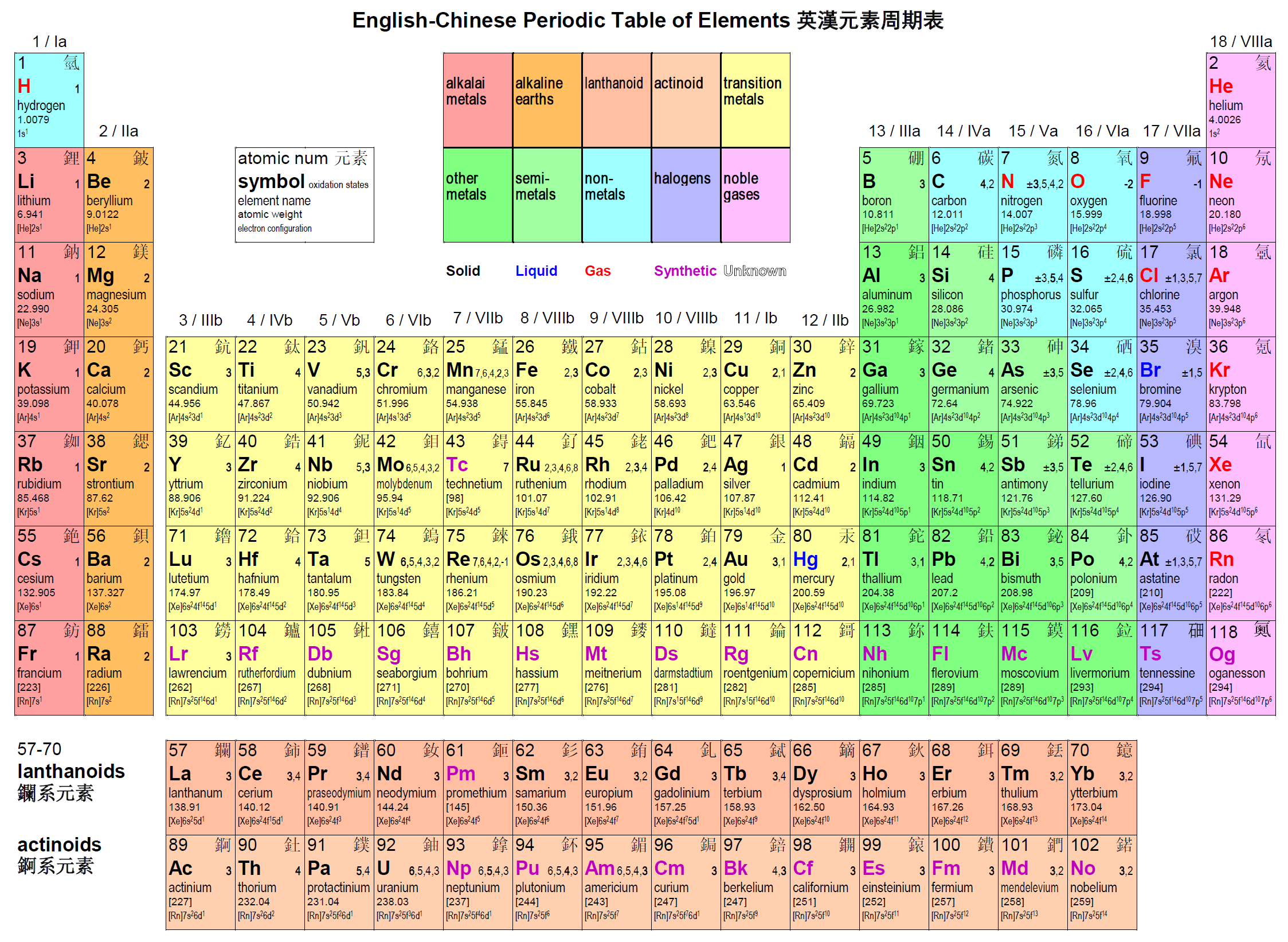
I hope other bilingual science enthusiasts will find it useful too!
I am currently doing some personal studying in chemistry/physics areas, using primarily a Chinese text. What I wish I had was a periodic table with the standard information (atomic number, atomic weight, symbol, name) AND with Chinese names of the elements. I couldn't find something with all those parts on the net, so I created my own version. Here it is for all to share:
Color version of English/Chinese periodic table of elements (PDF 110K)
I hope other bilingual science enthusiasts will find it useful too!
Subscribe to:
Posts (Atom)
